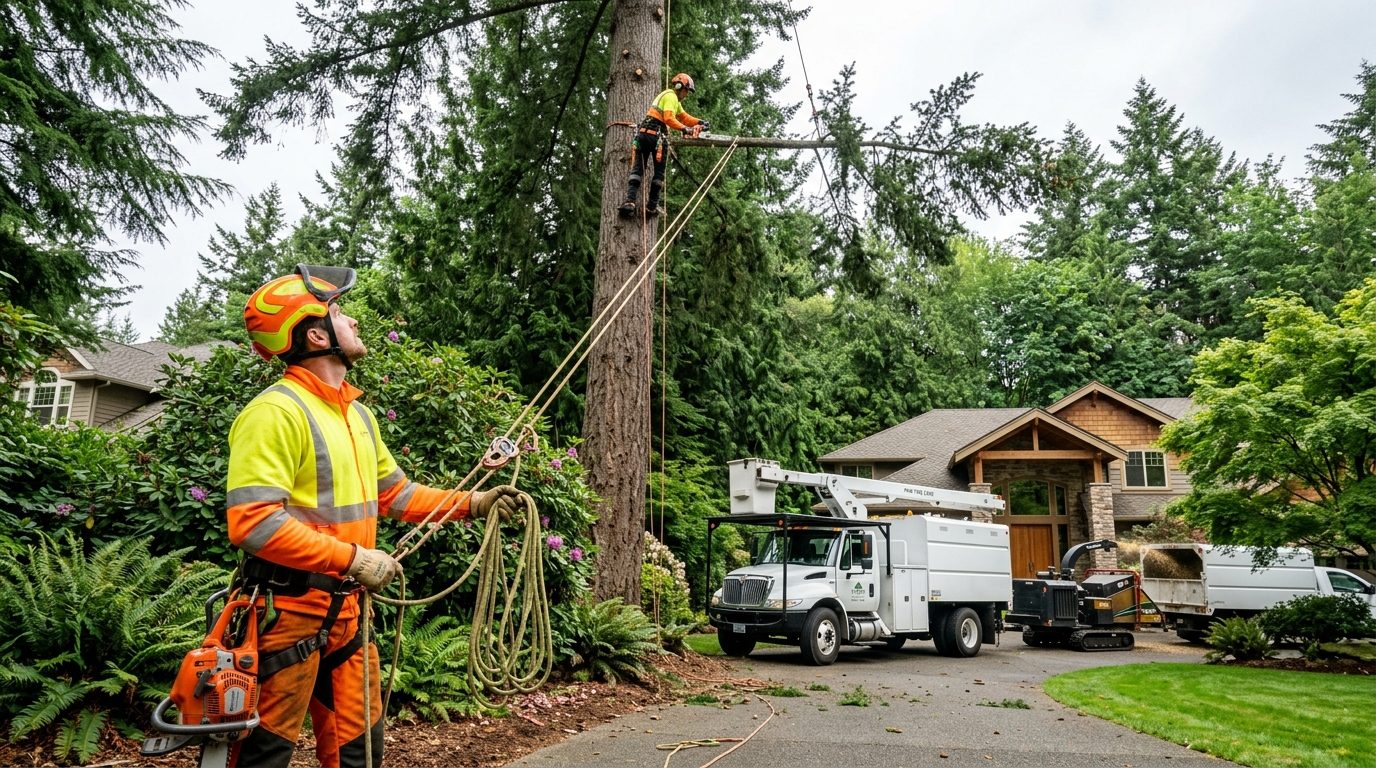
Permit guide for Olympia, WA
Olympia Tree Permit Guide
This is a plain-language summary of Olympia's tree removal rules, not legal advice. The City of Olympia Urban Forestry program makes the final determination on any specific parcel, so confirm before you cut.
Step 1: Confirm which jurisdiction covers your parcel
Tree rules in Thurston County depend on which jurisdiction your parcel sits in. Olympia city limits, Lacey, Tumwater, and unincorporated Thurston County each run separate codes with separate exemption thresholds. Check your address against city limits before assuming Olympia's rules apply, especially near the edges of West Olympia, Tumwater, or Lacey. If you are not sure, the City of Olympia's Urban Forestry page and permit desk can confirm jurisdiction and point you to the right code.
This page was checked against the published code on September 27, 2026. Codes change, so verify current text at the links below before you act.
Step 2: The general rule in Olympia
Under OMC 16.60.030(A), no one may remove or destroy any tree within Olympia city limits without first obtaining a tree removal permit, unless the activity is exempted under 16.60.040. Removal under this chapter is defined broadly: OMC 16.60.020(W) includes any act that causes a tree to die, including excessive pruning, root damage from machinery, soil compaction, or grade changes within the root zone. Ordinary maintenance pruning that does not impair tree health is not clearing under 16.60.020(E), so trimming a Douglas-fir or bigleaf maple to keep it healthy is different from removal in the eyes of the code.
Step 3: Exemptions from the permit requirement
OMC 16.60.040 lists activities exempt from the Soil and Vegetation Plan and tree removal permit requirement. In every case, the minimum tree density set by the chapter must still be maintained, and no landmark tree may be removed under any exemption without a separate landmark tree removal permit under Chapter 16.56.
- (B) Emergencies: removal necessary to protect public safety or property from imminent danger, as determined by the Urban Forester, or in response to a declared emergency from city, county, state, or federal government. Storm-damaged trees can fall under this exemption when the danger is imminent.
- (D) Hazard trees: a tree with a structural defect or disease that creates a high probability of failure close enough to harm people or property, as defined in 16.60.020(M).
- (E) Developed lots under two acres: single-family and multifamily properties (up to four units) under two acres, as long as minimum tree density is maintained.
- (F) Developed lots two acres or more: removal within 125 feet of the residence or other buildings; the remainder of the parcel is treated as undeveloped.
- (H) Undeveloped property: up to six trees per acre, capped at six trees total, within any 12 consecutive months.
- (L) Invasive species: species on the Urban Forestry Manual Appendix A list or Washington noxious weed lists.
Minimum tree density under 16.60.080(A) is 30 tree units per acre on the buildable area of the site. In the Green Cove Basin and RLI zones, the minimum rises to 220 tree units per acre under 16.60.080(B)(5). An exemption does not override this density floor.
Step 4: Landmark trees are a separate, stricter category
A landmark tree is not defined by trunk size. Under OMC Chapter 16.56, a landmark tree is a tree or group of trees the City has formally designated for exceptional value, such as history, rare species, or aesthetic quality. Designation requires nomination and review, and the tree is placed on the City's landmark tree register with a covenant recorded against the property. If the property owner does not approve the nomination, it is disapproved under 16.56.040(B).
No landmark tree may be removed without a tree removal permit, though emergency and hazard permits exist under 16.56.060(B). Major pruning of a landmark tree, meaning more than 20% of canopy or more than 10% of the root zone removed within a three-year period, requires a separate major pruning permit under 16.56.060(C).
Step 5: If you need a permit
A tree removal permit requires a Soil and Vegetation Plan under OMC 16.60.050(A). The City's Urban Forestry Manual sets report levels based on the project type: Level 1 for residential sites under five units, Level 2 for developed sites with an addition or disturbance, Level 3 for nuisance tree removals, Level 4 for new development with no existing trees, Level 5 for new development with trees present, and Level 6 for a conversion option harvest.
The City's public portal, linked from the Urban Forestry page, provides a Tree Exemption Affidavit, a Tree Permit Checklist, a Tree Permit Flow Chart, a Homeowner's Guide to OMC 16.60, and a Tree Unit Calculator to help scope your submission before you apply.
Under 16.60.060(B), an issued permit is valid for 180 days, or for the duration of an associated development permit, with one 180-day extension available. Per 16.60.060(D), the permit must be posted on the worksite before work begins.
Step 6: Other rules still apply
A tree removal permit does not exempt you from any other required permit under 16.60.070(A); where rules conflict, the more restrictive one governs. Activities in critical areas and their buffers can be restricted or conditioned under 16.60.070(B), and critical areas within city limits are separately regulated under OMC 18.32. If your parcel touches shoreline jurisdiction, additional Shoreline Master Program rules apply on top of the tree chapter.
If a tree is close to power lines, do not attempt the work yourself and stay clear of the lines; contact Puget Sound Energy. Any excavation near root zones should go through Washington 811 first to locate buried utilities.
Penalties for unpermitted removal
Under 16.60.130(F), knowingly violating this chapter is a misdemeanor, punishable by a fine of up to $1,000, up to 90 days in jail, or both. This is a legal penalty specified in the code, not a service cost.
If a tree on your property needs attention, whether it is windthrow risk after a winter storm, a hazard limb over a driveway, or a stump left from prior work, you can request an estimate or call (360) 822-3284 to be connected with a local provider, or start with the tree removal, emergency storm damage, hazardous tree trimming, or land clearing pages for more on each service.
Jurisdiction comparison
| Jurisdiction | General individual-lot exemption | Key condition | Source |
|---|---|---|---|
| Olympia (city limits) | Developed lots under 2 acres: OMC 16.60.040(E); undeveloped: up to 6 trees/acre, max 6, per 12 months under 16.60.040(H) | Minimum tree density (30 units/acre, or 220 in Green Cove Basin/RLI) must be maintained; no landmark tree without a permit | OMC 16.60 |
| Lacey | No more than 3 trees in any 60 consecutive months, LMC 14.32.050(D) | Minimum tree threshold under LMC 14.32.066 must be kept; not for historical trees or environmentally sensitive areas; City must issue the exemption before removal | LMC 14.32.050 |
| Tumwater | No more than 6 trees per parcel in any 3 consecutive calendar years, TMC 16.08.080(G) | Not for heritage/historic trees, greenbelt, wetlands, critical areas and buffers, or tree topping; a waiver letter from community development is required before removal | TMC 16.08.080 |
| Unincorporated Thurston County | No permit needed within a tree length of an existing permanent structure, if all trees are outside critical areas and buffers | Cutting within a critical area or buffer requires a Critical Area Review Permit; hazard tree permits typically need an arborist risk assessment; converting forest land may need a Class IV Forest Practice permit | Thurston County |
Frequently Asked Questions
Do I need a permit to remove a dead or hazardous tree in Olympia?
Hazard trees are exempt from the permit requirement under OMC 16.60.040(D), where a hazard tree is one with a structural defect or disease creating a high probability of failure close enough to harm people or property. You still need to confirm the tree meets that definition, and a landmark tree still requires a permit even if hazardous. Check with the City's Urban Forestry program if you are unsure whether a tree qualifies.
How many trees can I remove without a permit on undeveloped land?
Under OMC 16.60.040(H), undeveloped property can have up to six trees removed per acre, capped at a total of six trees, within any 12 consecutive months. Minimum tree density requirements under 16.60.080 still apply. This exemption does not cover landmark trees.
What makes a tree a landmark tree in Olympia?
A landmark tree is not based on trunk diameter or age. It is a tree or group of trees the City has formally designated through nomination and review under OMC Chapter 16.56, placed on the landmark tree register with a recorded covenant. The property owner must approve the designation, or the nomination is disapproved.
How long is an Olympia tree removal permit valid?
Under OMC 16.60.060(B), a permit is valid for 180 days, or for the length of an associated development permit, whichever applies. One 180-day extension is available. The permit must be posted on the worksite before work begins, per 16.60.060(D).
What happens if I remove a tree in Olympia without a required permit?
Knowingly violating OMC Chapter 16.60 is a misdemeanor under 16.60.130(F), carrying a fine of up to $1,000, up to 90 days in jail, or both. This applies whether the removal happens directly or through actions that cause a tree to die, such as root damage or grade changes in the critical root zone.
Request an Estimate
Share a few details and a phone number. An independent local provider can call you to talk through the job, look at the site, and give you a written estimate.
- Describe the tree, where it stands, and what is nearby: roof, fence, driveway, or power lines.
- Ask the provider to confirm registration, insurance, scope, cleanup, and schedule in writing before work begins.
- For an urgent hazard, call (360) 822-3284 instead of using the form.
Project details
Phone is the best way to reach you about a tree-service request.
Talk Through Your Tree Project
Call to describe the tree and get connected with an independent local provider.