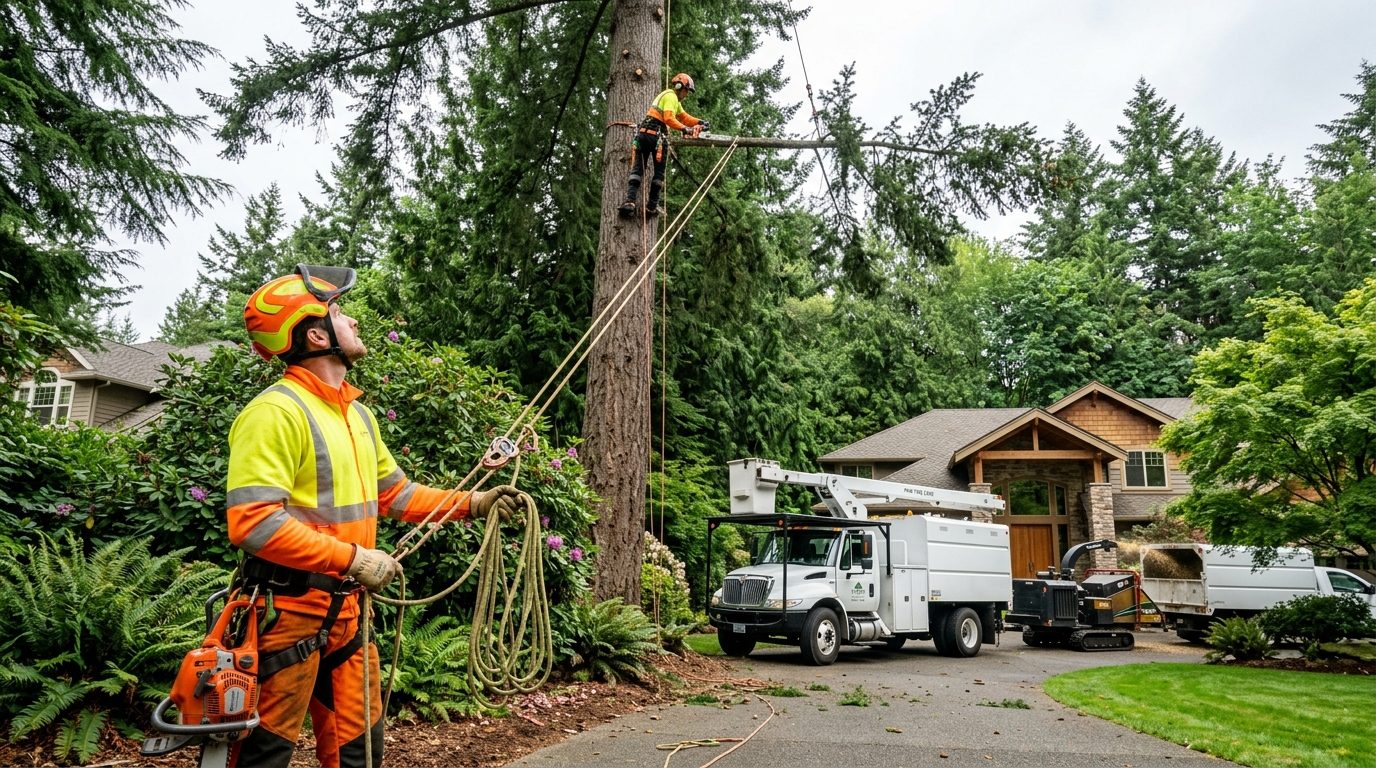
Pruning in Olympia, WA
Tree Trimming & Pruning in Olympia, WA
Get connected with an independent tree care provider serving Olympia and Thurston County for routine pruning, crown work, and clearance cuts. Call (360) 822-3284 or request an estimate online.
Pruning types a provider may recommend
Arborists working under ANSI A300 standards describe pruning by the goal it serves. When you request an estimate, ask which of these apply to your tree:
- Crown cleaning: removal of dead, dying, diseased, or weakly attached branches from the canopy.
- Crown thinning: selective removal of branches throughout the canopy to reduce density and let more light and air through, without changing the tree's overall shape.
- Crown raising: removal of lower limbs to create clearance over a driveway, walkway, roofline, or sightline.
- Crown reduction: shortening branches back to a lateral of adequate size, used to reduce the size or spread of a tree without the damage topping causes.
Ask the provider to avoid topping. Cutting main limbs down to stubs forces weak, fast-growing sprouts that attach poorly and often fail in wind years later. A provider working to ANSI A300 will use reduction cuts instead.
Pruning goals for common Olympia and Thurston County trees
Different species on different lots call for different pruning approaches. A provider should be able to explain the reasoning behind each cut on your tree.
- Douglas-fir: homeowners often ask for limbing up (crown raising) on lower branches near structures, driveways, or power line clearance. Removing too much live crown at once stresses the tree, so a provider should limit how much is taken in a single visit.
- Bigleaf maple: these grow large canopies quickly on Thurston County lots and often need crown thinning or reduction to manage weight over roofs and reduce wind sail effect during Puget Sound storms.
- Fruit trees: dormant-season pruning is common practice for many deciduous fruit trees, since it is easier to see branch structure without leaves and the tree isn't actively pushing new growth. A provider can advise on timing for your specific variety.
- Ornamental Japanese maples: these respond best to light, selective pruning rather than heavy cuts. Removing too much canopy at once can stress the tree and change its form permanently.
Clearance from roofs, gutters, and structures
Limbs that overhang a roof drop needles, moss, and leaf litter into gutters and valleys, which holds moisture against roofing material and shingles. Branches that rub against a roof or siding during wind can also wear through surfaces over time. Crown raising and selective limb removal create clearance without requiring a full crown reduction.
If branches are growing into or near overhead utility lines, contact Puget Sound Energy first. PSE handles utility line clearance, and nobody should prune near energized lines without the utility involved.
How much pruning is too much
Removing too much foliage in one visit stresses a tree's ability to photosynthesize and can invite pests or decay into the wound sites. Olympia's code treats it as a legal question too. OMC 16.60.020(W) defines "removal" to include excessive pruning that causes a tree to die, along with root damage from machinery, soil compaction, and grade changes within the root zone. That means an overly aggressive pruning job could legally count as tree removal, which triggers the city's permit requirements under OMC 16.60.030(A).
On the other side, OMC 16.60.020(E) states that pruning consistent with accepted horticultural practices, done in a way that doesn't impair tree health, is not considered "clearing" under the ordinance. Routine, properly scoped pruning by a provider following accepted practices generally falls outside permit territory. Confirm your specific situation with the City of Olympia before major work, especially on a large or mature tree.
If your tree is on the city's landmark tree register under OMC Chapter 16.56, different rules apply. Major pruning of a landmark tree, defined as removing more than 20% of the canopy or more than 10% of the root zone within three years, requires a major pruning permit under OMC 16.56.060(C). Landmark status comes from formal city designation and registration, not from a tree's size or species, so check with the city if you're unsure whether a tree on your property is registered.
Comparing trimming estimates
Pruning estimates can vary widely between providers because the scope of work varies. When you request an estimate, ask each provider to specify:
- Which trees are included and what type of cut is planned for each (cleaning, thinning, raising, or reduction).
- Whether the work will be done by climbing or with an aerial lift, since access affects both cost and technique.
- What cleanup is included: chipping and hauling brush, or leaving debris on site.
- Whether the estimate covers one visit or an ongoing maintenance schedule.
For general cost ranges on tree work, see our tree removal cost guide, which covers national and Washington state typical price ranges from third-party sources. This page does not include pricing since trimming scope varies too much between properties to generalize.
If a tree has large dead limbs over a structure, walkway, or area where people gather, that's a different job than routine pruning. See hazardous tree trimming for guidance on risky limb removal. If an arborist determines the tree itself is failing or should come down rather than be pruned, see tree removal for next steps.
Frequently Asked Questions
When is the best time to prune trees in Olympia?
Dormant-season pruning is common practice for many deciduous trees, including fruit trees, since branch structure is easier to see without leaves. Evergreens like Douglas-fir can often be pruned at other times of year for clearance or dead-wood removal. A provider can recommend timing based on your specific tree species and goals.
Do I need a permit to prune a tree in Olympia?
Routine pruning consistent with accepted horticultural practices that doesn't impair tree health is not considered clearing under OMC 16.60.020(E) and generally does not require a permit. However, excessive pruning that kills a tree can legally count as tree removal under OMC 16.60.020(W), which does require a permit. Confirm your specific situation with the City of Olympia before major pruning work.
Can a tree service trim branches near power lines?
Contact Puget Sound Energy first. PSE handles line clearance for Olympia and Thurston County, and nobody should prune near energized lines without the utility involved.
What is topping and why do arborists avoid it?
Topping means cutting main limbs or the main trunk down to stubs rather than making proper reduction cuts back to a lateral branch. It forces weak, fast-growing regrowth that attaches poorly to the tree and is more likely to fail in future windstorms. A provider following ANSI A300 standards will use crown reduction instead.
What if my tree is on the landmark tree register?
Landmark trees are individually designated and registered by the City of Olympia under OMC Chapter 16.56, not defined by trunk size. Major pruning of a landmark tree, meaning more than 20% of the canopy or more than 10% of the root zone within three years, requires a major pruning permit under OMC 16.56.060(C). Check with the city if you're unsure whether your tree carries this designation.
Request an Estimate
Share a few details and a phone number. An independent local provider can call you to talk through the job, look at the site, and give you a written estimate.
- Describe the tree, where it stands, and what is nearby: roof, fence, driveway, or power lines.
- Ask the provider to confirm registration, insurance, scope, cleanup, and schedule in writing before work begins.
- For an urgent hazard, call (360) 822-3284 instead of using the form.
Project details
Phone is the best way to reach you about a tree-service request.
Talk Through Your Tree Project
Call to describe the tree and get connected with an independent local provider.